
CULTURE
The Boston Globe · 2025

Joon Lee, who has been a sportswriter for ESPN and The Washington Post, talks about sports on YouTube @iamjoonlee.
When Marty Walsh was mayor and wanted a gut check on Boston, he didn’t turn to a political adviser or scroll through Twitter. Sitting in traffic from Dorchester to City Hall, he tuned the radio dial to hear how the city felt that day. When sports fans were pissed about the Patriots, it was rarely just about the Patriots. It reflected the city’s mood on bike lanes, snow removal, and the T. Walsh needed that anger index the way mayors need snow totals. As Walsh put it, understanding sports is understanding Boston.
“As the mayor, you’re making sure that the water and the sewers are working, the streets are plowed,” Walsh told me in March. “But sports radio connects you to Boston in another, different way.”
And for more than a decade, the person setting that temperature hasn’t been the mayor, a professor, or a CEO. It’s been Michael Felger, cohost of “Felger & Massarotti” on 98.5 The Sports Hub, the city’s highest-rated radio show.
Felger didn’t invent the genre. He just adjusted the voltage. Since 2009, “Felger & Mazz” — with cohost Tony Massarotti, a longtime sportswriter for the Globe and the Boston Herald — has delivered a daily litany of complaints, forensic breakdowns, and gallows humor. Felger railed for years against Patriots owner Robert Kraft’s frugality, arguing that the “Patriot Way” was little more than a branding slogan for cutting costs during the Brady-Belichick years. He’s hammered the Celtics’ new ownership for hiding behind the “second apron” of the luxury tax, calling it a convenient excuse to avoid spending what it takes to win.
In March, Felger ranted on the air about how difficult and expensive it’s become to watch sports on television.
“A lot of us have cut the cord, especially just this past year. NESN and NBC Sports Boston unfortunately jacked up the rates again, so eff you, I’m not going to do that,” Felger said. “I’m going to cut the cord, I’ll get YouTube TV. Ah, NESN’s not on YouTube TV. So you get Fubo. Well, if I get Fubo, you know what I can’t get on Fubo? TNT. So I can’t see NBA nationally televised games, which is the best product going. I don’t get that if I have Fubo. So eff you, Fubo.… Don’t you get sick of getting digitally penetrated? Every time you want to watch a ball come across your TV screen.”
In a city where politicians cycle out and team owners stay hidden behind tinted glass, Felger has been the loudest, clearest, and most consistent voice. Not just in sports — in anything. For 15 years, no one has moved the mood of Boston more than he has. “Felger & Massarotti” has long earned 25 percent of Boston’s radio listenership among men 25-54. Walk into any bar and you’ll hear echoes of Felger’s monologue. He sets the agenda. He starts the fights. He gives people language to explain how they feel — often before they’ve figured it out themselves.
Rawer, meaner, sharper
Felger, 55, did not arrive with the local pedigree Boston usually demands of its sports media icons. Longtime Globe columnist Dan Shaughnessy, for example, grew up in Groton, while his rival, Herald columnist Steve Buckley, grew up in Cambridge. Glenn Ordway — the former drivetime radio host of “The Big Show” at WEEI — was raised in Lynn. Felger grew up in Milwaukee, a city whose relationships with its local teams are loving and pathologically polite.
“In Wisconsin, you’re just kind of happy to be invited, happy to be mentioned, happy to be on the stage, but you understand you’re not going to win it,” Felger told me in February. “People back home don’t treat sports that way I do. Here, it’s different. That intensity, that whole thing, I liked better. It was refreshing for me.”
He enrolled at Boston University, inhaled the cigarette cloud at the old Boston Garden, and felt something snap into place.
He interned and eventually started writing for the Herald, covering the Bruins and Patriots. As he rose in prominence among the city’s sportswriters, he listened to WEEI, then the city’s only sports radio station, which to his ear sounded suspiciously chummy. As Tom Brady and the Patriots turned Boston into Titletown in the mid-2000s, WEEI hosts were celebrating with team executives on the air and exchanging Christmas cards with general managers. The callers went soft on their favorite teams and were less critical. Felger went on Ordway’s show, but he felt dissatisfied with the state of sports radio.
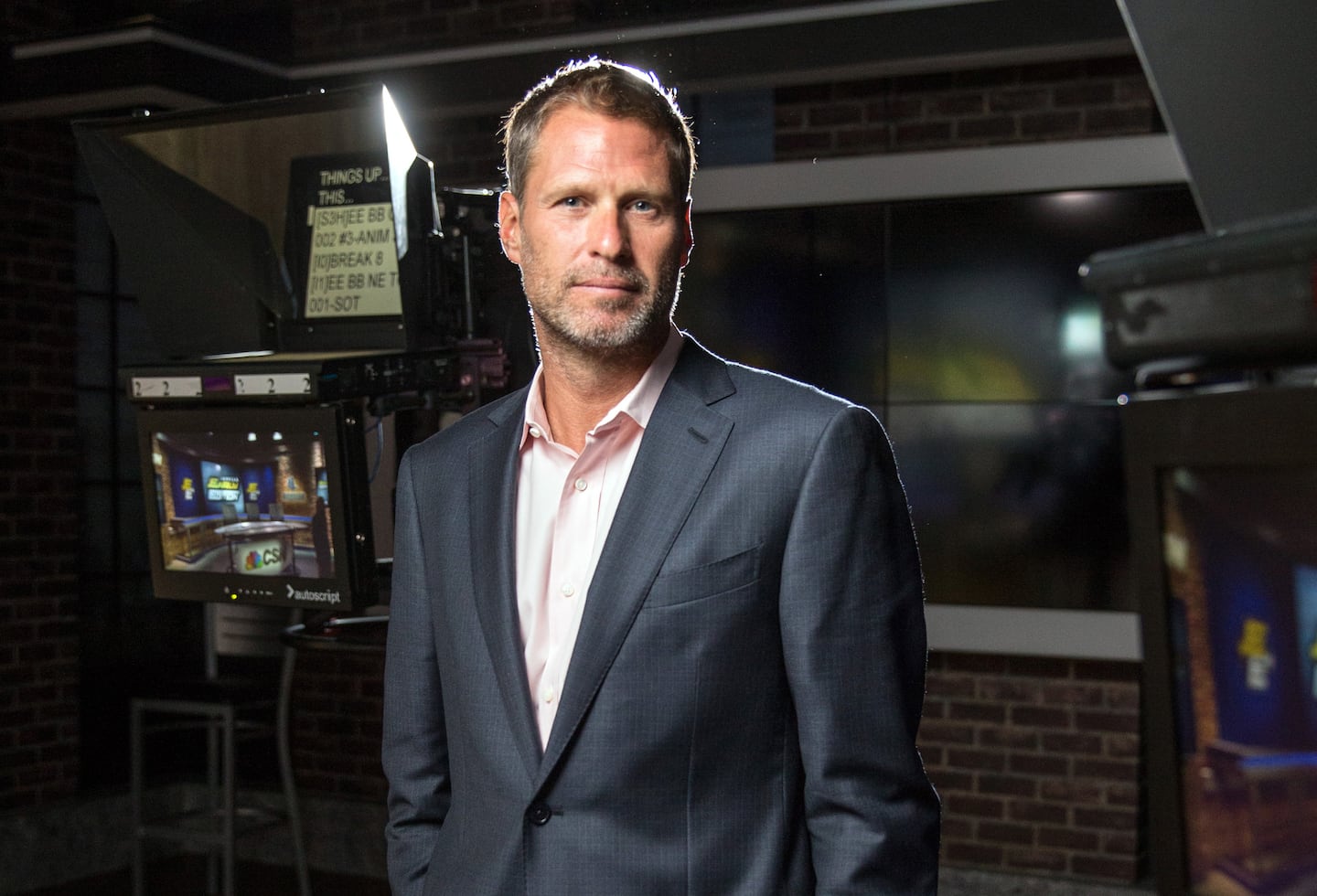
Felger at CSN New England's studios in Burlington in 2017.Aram Boghosian for The Boston Globe
“I wanted to do more of the stuff we weren’t doing on WEEI,” Felger said. “Classic sports talk radio has been critical, fast-paced, topical, and not drifting around and losing focus. Did I mention being critical? It’s important for sports radio. It’s a critical medium.”
In 2009, when CBS launched 98.5 The Sports Hub, Felger saw the opportunity to do sports radio the way he thought it should be done: something rawer, meaner, and sharper. He teamed up with Massarotti — whom he’d met when they were colleagues at the Herald — who was then writing acerbic sports columns for the Globe, channeled his idol Howard Cosell, and pushed back against fans’ instincts for constant celebration.
“I wanted to tell it like it is,” Felger said. “I wanted to dip my toe into the fellowship of the miserable and the negativity.”
As “Felger and Mazz” producer James Stewart says, “When sports radio started in Boston, the fans would call up and be like, ‘This team’s never going to win,’ and [Ordway] would say, ‘Well, don’t jump off the Tobin yet.’ But with Felger, it’s like, ‘Yeah, it might be time to jump off the Tobin.’”
Massarotti keeps things from flying off the rails. If Felger is the accelerant, Mazz is the afterburn — grimacing, interrupting, pushing back just enough. He gives the show shape and rhythm, keeping it from veering into total cynicism. He’s part instigator, part guide — someone who knows when to challenge Felger and when to let the chaos cook. The show also benefits from the presence of a third character — Jim Murray, whose dry wit and timing have made him a fan favorite and a subtle counterweight to Felger’s intensity.
“I’m sure you all have people like this. My wife is like this,” Felger said on the show one afternoon in April, kicking off a rant. “She’s got a relative on the phone.”
“Oh you want to say hi to so-and-so?” Massarotti added, throwing propane on the fire.
“You want to say hi to Aunt Millie? Say hi to Aunt Millie!” Felger yelled.
“Hi, Aunt Millie!” Massarotti exclaimed.
“Hi, Aunt Millie, oh, yeah, yeah,” Felger said. “And you start passing the phone around the room. My wife doesn’t get how painful that is. Talk to so-and-so. No, you talk to so-and-so!”
Two years after they debuted, “Felger & Massarotti” was the most popular radio show in the city.
The corporatization of sports
Meanwhile, Boston was diversifying — becoming a majority-minority city in 2000, with the foreign-born population reaching 29 percent in 2021, 16 points higher than it had been in 1960. Boston was becoming less provincial, with tech, academia, and health care exploding across the city. Major national chains expanded into areas like the Seaport, which transformed from a parking lot to a luxury playground.
As Boston changed, The Sports Hub’s biggest rival, WEEI, calcified around an old idea of Boston that was increasingly out of step with the city. In the early 2010s, the station’s identity started to drift. (I was an intern at WEEI in 2013.) Its banter began to curdle into something more overtly political. Some shows veered into broader social commentary, often echoing the language of Fox News. On-air debates drifted from pitch counts and power players to rants about race, gender, and grievance. Sports talk blurred into something else entirely.
“A lot of people did want to hear the politics, but there were a lot of people that didn’t,” says Michael Holley, who hosted shows at WEEI from 2005 through 2018 and now cohosts a show with Felger on NBC Sports Boston. Holley says that WEEI at the time veered into conservative political commentary in ways that alienated parts of the audience. “Sometimes when you’re so locked into politics, even when you’re talking about sports, you can feel that there’s something going on underneath. What’s not being said?”
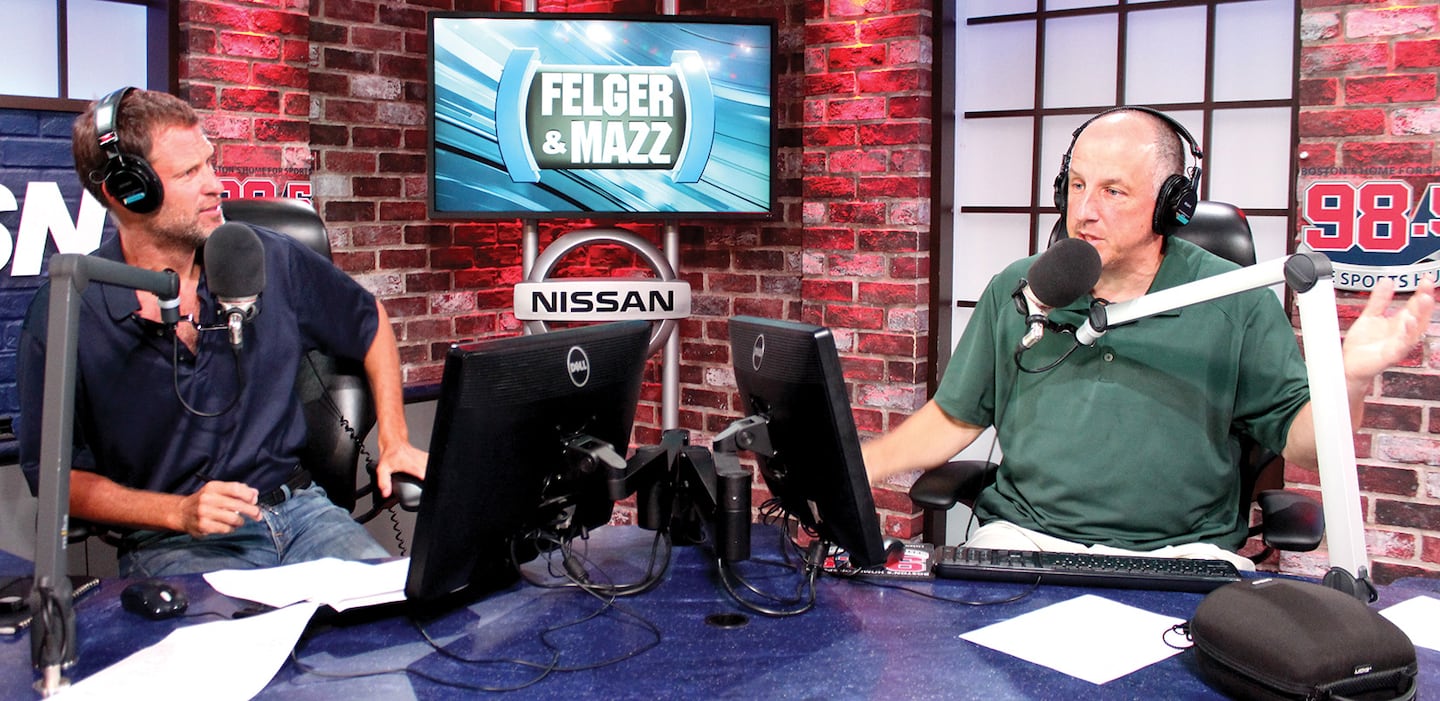
Mike Felger and Tony Massarotti in 2017.
Felger took a different path. “Whatever his political positions were,” Holley says, they “were generally far in the background.” He wasn’t interested in gatekeeping the culture. He stuck to his North Star: skepticism. The same instinct that led him to question a cornerback’s contract extension or second-guess a manager’s pitching change also applied when he talked about the people in charge. Team owners weren’t benevolent caretakers: They were billionaires trying to squeeze as much value out of a team as possible. Fans weren’t helpless marks, but they were often being taken advantage of.
That sensibility stood out at a time when Boston’s institutions — its teams, its media, even its politics — were increasingly shaped by corporate interests.
The clearest sign of Felger’s growing influence came in 2011, when Red Sox owner John Henry, who owns the Globe, walked into 98.5 The Sports Hub to confront Felger on air. Henry was furious over the show’s portrayal of the team as leakers and backstabbers in the wake of manager Terry Francona’s firing — and especially the insinuation that details of Francona’s personal life had been planted in the media by the front office. Felger didn’t back down.
The biggest reason Felger endures is that he channels the Boston that actually exists today — not the one frozen in black-and-white photographs of Southie taverns and cigar smoke.
Felger’s show isn’t perfect. He’s had his stumbles, like when he called former Major League Baseball pitcher Roy Halladay a “moron” for piloting a stunt plane that crashed, leaving his young children fatherless. Most recently, Felger received criticism when he hammered Red Sox manager Alex Cora for missing a game for his daughter Camila’s graduation from Boston College. And the program has had moments that forced internal reckoning, including a racially insensitive joke Massarotti made about two Black men in New Orleans, which sparked outrage among listeners locally and nationally.
But in a city still shaking off its reputation for being hostile to outsiders, Felger’s response to the backlash against Massarotti stood in stark contrast to the defensive posture that once defined WEEI. He addressed it directly, gave space for reflection, and didn’t make himself or the show a victim. “Minorities in this country do have to put up with a lot of crap, and comments like that just make it harder for them. We apologize for that,” Felger said on air. “I feel bad that I personally didn’t do more to correct it in the moment. I had a chance in just a split-second moment to do something, and I guess I just froze. So I feel bad about that.”
The city has kept changing too. In 2021, Michelle Wu became the first woman and person of color elected mayor of Boston — a moment that felt inconceivable to me as a Korean-American growing up in Brookline during Tom Menino’s reign. Wu, like Felger, came to the city for school and never left. She didn’t look or sound like Boston’s old guard. But she came to represent what the city was becoming: younger, more diverse, less beholden to the institutions that once defined it.
The biggest reason Felger endures is that he channels the Boston that actually exists today — not the one frozen in black-and-white photographs of Southie taverns and cigar smoke. Whether it’s torching billionaires for pretending to be poor or ripping MLB for turning the simple joy of watching a game on TV into a scavenger hunt, Felger plays the part Boston needs: the guy who still refuses to be bought off or distracted.
He also embodies something essential about a city that doesn’t always welcome change but that can’t help evolving anyway. You can hear it in his caller board. It long ago stopped being the province of Irish and Italian lifers (although they still call in). These days, Felger and Mazz get calls from Roxbury, and even the occasional call from another state or another country. Felger speaks a dialect everyone recognizes: caffeinated and skeptical.
Felger’s greatest strength may be his clarity, but it can also read as rigidity. He’s a little grumpier, a little more suspicious of anything new — streaming, social media, stats — like someone who still thinks the microwave is cutting-edge. He’s not always in sync with how younger fans engage with sports. The show’s ratings have slipped — down from an 18.4 share last spring to 12.2 this year among men 25-54. That’s still quadruple the competition at WEEI. But listeners are increasingly tuning in to podcasts.
Like Felger, Wu didn’t fit the mold of what Boston leadership used to look like. Does she ever listen to his show? Her office did not respond to requests for comment. As for her main rival in this year’s election, Josh Kraft — whose father Robert remains one of Felger’s favorite punching bags — he says he turns on both The Sports Hub and WEEI. “Sports radio is great because it can test the temperature of what’s going on,” Kraft told me. “And they know how to maximize that temperature of what’s going on. But sports radio is entertainment.”
Kraft sounds a little dismissive of these shows. But his comment also captures something bigger: Sports radio doesn’t just reflect Boston’s mood but shapes it. It stokes and channels emotion. It’s not just a mirror but a lever.
Felger didn’t bend the city to fit him. The city bent toward him — and toward the many Bostonians like him who’ve shaped what it’s becoming.